

Your Project Profitability Is a Lie
You think you're tracking project profitability, but you're just subtracting costs from revenue. This simple view ignores the real drivers of margin erosion.
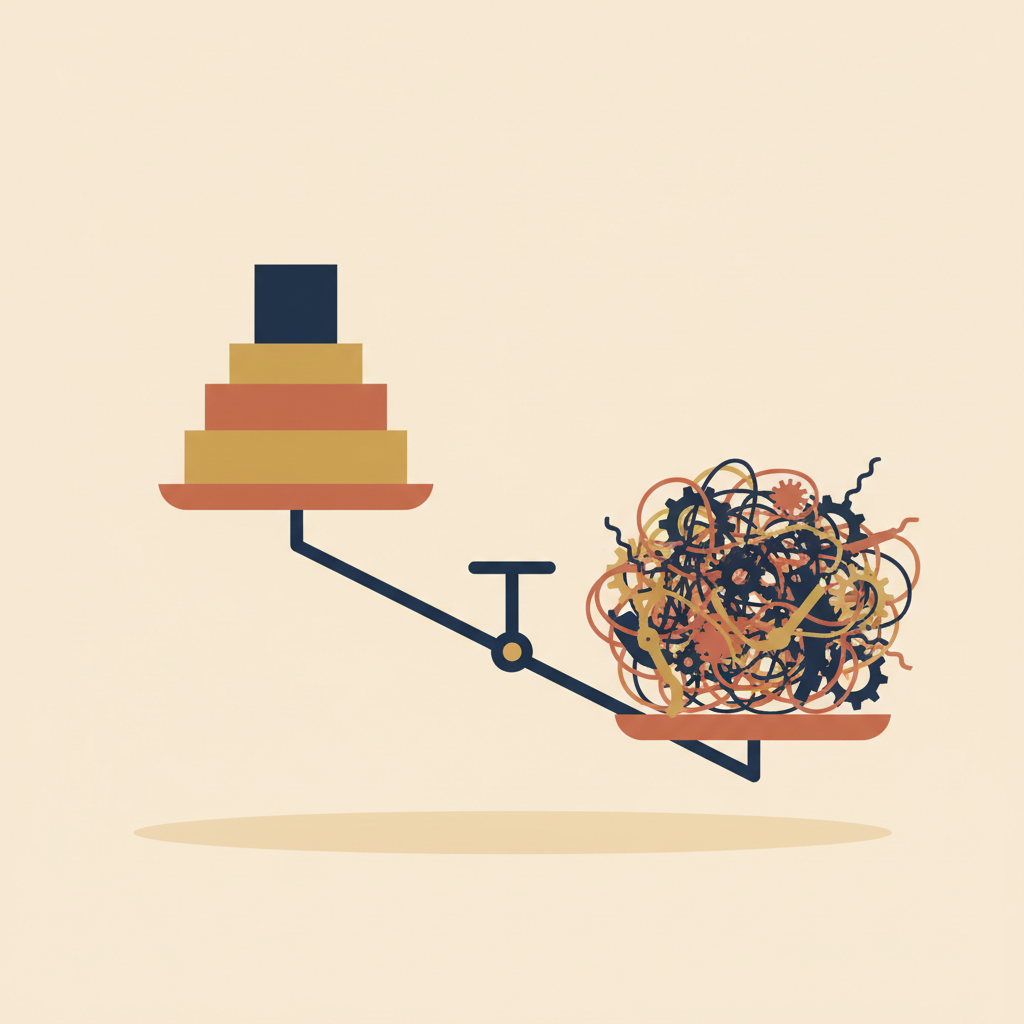
Your project profitability calculation is a lie.
You probably track it like this: Project Fee - Direct Costs - (Hours x Rate) = Profit.
This simple math makes you feel in control. It gives you a tidy number to put in a spreadsheet. It’s also completely wrong. This lagging, financial-only view ignores the operational realities that actually determine whether a project makes or breaks your business.
The real costs aren't on a timesheet. They are the hidden thieves of your margin: operational drag, context switching, and client management overhead. You are measuring the wrong things, and it’s actively hurting your business.
The Trap of Billable Hours
For a service business running on fixed-price projects, tracking billable hours is a trap. It’s a relic from an outdated model that incentivizes the wrong behavior. When you focus solely on hours logged, you're not measuring value created; you're measuring time spent sitting in a chair.
This approach encourages “efficiency theater.” Your team learns to look busy and fill out timesheets, not to solve client problems effectively. It penalizes the senior team member who solves a complex problem in 30 minutes and rewards the junior who takes four hours to do the same task. You are incentivizing inefficiency.
Billable hours fail to capture the true cost of a distracted, fragmented team. Your profitability isn't just about the hours spent directly on a task. It's about the costly momentum-killers that happen in between.
The Three Hidden Margin Killers
Your margin isn't eroded by an extra hour of design work. It’s obliterated by a thousand tiny cuts from operational friction. Here are the real culprits.
Operational Drag
Operational drag is the friction in your process. It’s the unclear brief, the missing client asset, the password you have to ask for three times. It’s every moment your team is ready to work but can’t because something is stuck.
Think about a designer waiting for brand guidelines or a developer blocked by a missing API key. No hours are being logged against the project, so on paper, everything looks fine. In reality, momentum is dead. The project has stalled, a team member is now idle, and they'll have to spend time later getting back up to speed. This invisible cost doesn't show up in your simple profitability formula.
Context Switching
Context switching is the mental tax your team pays for jumping between different tasks, projects, clients, and communication tools. Every time a developer gets an “urgent” Slack message while deep in code, or a project manager has to pivot from one client fire to another, a cognitive cost is paid.
Research shows that context switching can consume up to 40% of a knowledge worker's productive time. That's two full days a week, gone. This loss is never logged on a timesheet. It’s a massive, invisible drain on your team's capacity and your project’s profitability.
Client Management Overhead
This is all the unbillable communication and hand-holding required to keep a project moving and a client happy. It’s the endless “just checking in” emails, the unscheduled 15-minute calls to “quickly go over something,” and the time spent re-explaining scope for the third time.
Your tools either help or hurt you here. A disorganized mess of email threads, Slack DMs, and Google Docs amplifies this overhead. A well-structured client portal, like you can build with SuiteDash, centralizes everything. When a client knows exactly where to find the latest file, approve a task, or ask a question, this overhead shrinks dramatically. Platforms like HoneyBook and Dubsado offer portals, but they lack the deep integration needed to truly run complex projects, often forcing you back into email.
A Better Framework: Tracking Leading Indicators
To protect your margins, you must shift from tracking lagging financial data to leading operational indicators. Stop asking, “Were we profitable?” and start asking, “Are we operating in a way that ensures profitability?”
This means measuring the operational health of a project in real-time.
Here’s how the old way compares to the new:
| Old Metric (Lagging) | New Metric (Leading) | What It Tells You | Tool to Track It | | :--- | :--- | :--- | :--- | | Total Hours Logged | Revision Cycles per Task | Is the scope clear? Is the initial work high-quality? | ClickUp, Asana | | Budget vs. Actual | Time-to-First-Response | Is your team responsive? Is the client engaged? | SuiteDash Messages/Help Desk | | Project Profit Margin (%) | Days Awaiting Client | Where are the bottlenecks? Is the client delaying the project? | ClickUp Statuses | | Employee Utilization Rate | Team Morale Score | Is this project burning out your team? | Simple form/survey in SuiteDash |
How to Implement This in Your Stack
You don’t need a host of new, expensive software. You need to use your existing tools with more intention. Your project management software and client portal are your new command center for profitability.
In Your Project Management Tool (e.g., ClickUp)
Stop using ClickUp as a simple to-do list. Turn it into an operational intelligence engine.
- Use Statuses Intelligently: Don't just have "To-Do," "In Progress,” and "Done." Create statuses like "Awaiting Client Feedback," "Blocked by Assets," and "Internal Review." The time a task spends in these statuses is a direct measure of operational drag.
- Track Revision Cycles: Create a custom field for "Revision Count." Use automations to increment this field every time a task is sent back for changes. If a single task hits three or more revisions, it's a red flag that signals a problem with scope, communication, or execution.
- Build a Dashboard: Create a dashboard that visualizes these leading indicators. Show "Tasks Awaiting Client > 2 Days," and "Average Revision Cycles by Project." This is the foundation of a robust systems setup.
In Your Client Portal (e.g., SuiteDash)
Your client portal should be the single source of truth for every project. The goal is to eliminate unstructured communication and centralize everything.
- Mandate Portal Communication: Ban client project communication via email and internal project chatter on Slack. All questions, files, and approvals must live in your SuiteDash portal. This creates an un-gameable record of communication and response times.
- Leverage Integrated Tools: Unlike GoHighLevel which casts a wide but shallow net, SuiteDash offers deeply integrated tools perfect for service businesses. Use SuiteDash Projects to manage phases and tasks where the client can directly participate. Use Secure Messaging for communication and the File Exchange for all assets. This discipline is what separates professional operations from amateur hour.
In Your Team Cadence
Your weekly project meetings need to change. The conversation is no longer a financial post-mortem.
Instead of asking, "Are we on budget?" you should be asking:
- "Where are we stuck? What's been 'Awaiting Client' for more than 48 hours?"
- "Project X has an average of 4.2 revision cycles per design task. Why? Is the brief wrong, or is the client changing their mind?"
- "The team sentiment score for Project Y is trending down. Is the client difficult, or is the scope unclear?"
This transforms your team from reactive ticket-closers into proactive project-healers. You will solve problems when they are small, not after they have already destroyed your margin.
True project profitability isn't a number you calculate at the end of a project. It’s an operational state you must create and defend every single day. By focusing on leading indicators, you can finally see the whole picture. You protect your margins, shield your team from burnout, and deliver a better, more professional experience for your clients.
This shift from financial accounting to operational excellence is not trivial. It requires a deep understanding of strategy, process, and systems. If you're a founder running a business in the $500k–$5M range and this diagnosis feels painfully accurate, it might be time for help. As an Atlanta fractional COO and certified SuiteDash Sensei, we help service businesses build the operational engine they need to scale profitably. Let's fix your profitability metrics—and your business—for good.
operations · profitability · project management · systems